
Written By: Stephanie Rojas | November 20, 2026
Time to Read 13 Minutes
Your property's rental income can take center stage, even when your paycheck doesn't. A real estate investment loan with no income verification in Texas is generally a DSCR loan: instead of relying on W-2s or pay stubs, the lender evaluates the property's expected rent and your credit profile. “No income verification” doesn't mean no review.
It makes sense to look for a real estate investment loan with no income verification in Texas that accounts for a property’s earning potential. This guide explains how rental-income-based financing assesses rent against debt payments, which property and borrower details can matter, and how it differs from conventional loans that rely on personal income documentation. You’ll also learn where Texas loan options may fit different rental strategies, so you can plan your next steps with a clearer view of the financing process.
Yes. Texas investors can use rental-income-based financing without relying on personal employment documents. Lenders still assess credit, property income, and whether projected cash flow can cover debt service.
Personal income verification looks at the borrower’s earnings, often through employment records. Property cash flow instead focuses on the investment property’s ability to generate rent against its debt obligations. A DSCR loan uses this property-centered approach. The lender evaluates rental income and expenses, so a strong salary does not compensate for a property whose cash flow falls short.
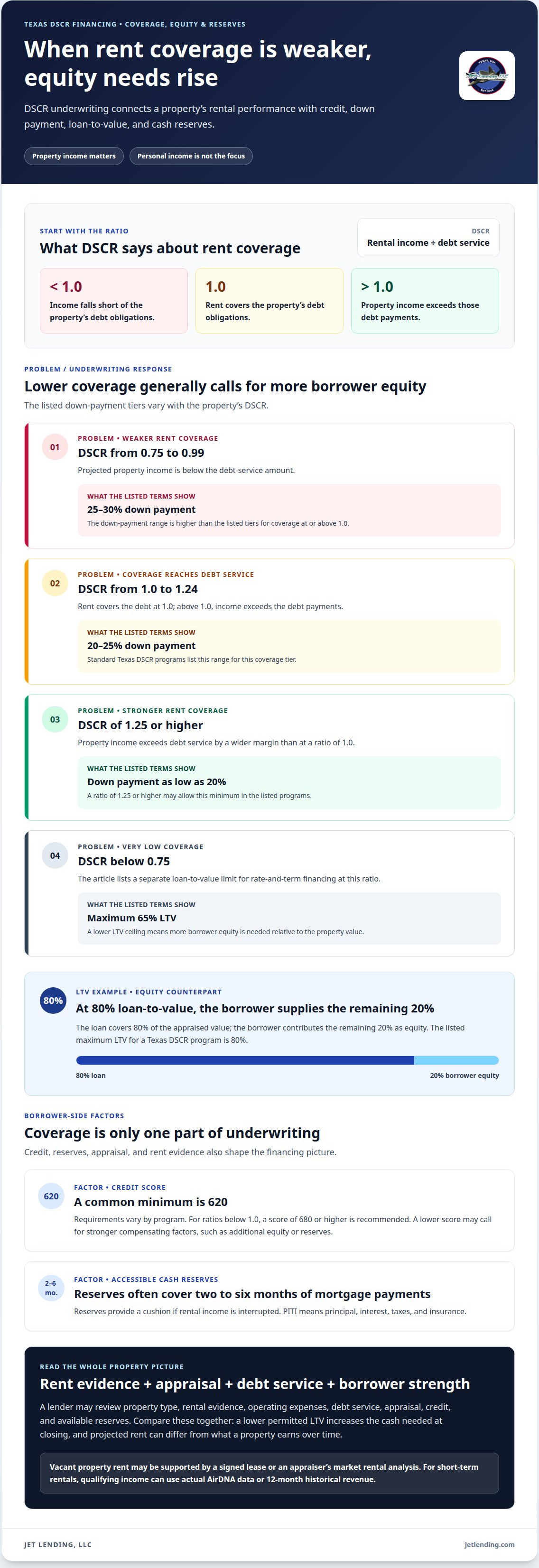
For a rental-income-based loan, the lender compares income from the property with its debt service. Debt service coverage ratio, or DSCR, measures that relationship. A DSCR of 1.0 means rent covers the property’s debt obligations; a ratio above 1 means income exceeds those payments. Texas DSCR programs can accept a minimum ratio of 0.75, with other terms affecting qualification.
Eligible properties depend on the loan type. Conventional investment property loans generally cover residential properties with one to four units. DSCR financing may assess other income-producing investment properties through their rental potential and debt service coverage. For short-term rentals, Texas programs can establish qualifying income using actual AirDNA data or 12-month historical revenue.
Can Texas investors get no-income-verification loans for short-term rentals or vacant properties? Short-term rentals can qualify when income is supported by actual AirDNA data or 12-month historical revenue. For a vacant property, a signed lease or an appraiser’s market rental analysis can support projected rent. A lender evaluates the evidence of income, rather than treating an empty unit as collected rent.
Cash-flow risk matters because projected rent can differ from what a property earns over time. Vacancy can interrupt rental income, while operating expenses reduce the amount available for debt service. If projected income only just covers the mortgage payment, a shortfall can leave less room to meet obligations. The DSCR calculation helps show that risk before financing moves ahead.
Matching a loan to a borrower and property means considering both the asset and the requested financing. A lender may review property type, evidence of rent, operating expenses, debt service, and the borrower’s credit profile. A one-to-four-unit residential rental may fit conventional financing, while an investor focused on rental performance may consider a DSCR loan. Property income records help determine which assessment applies.
Texas DSCR underwriting weighs credit, property value, rent coverage, and available reserves. A common minimum credit score is 620; down payment and reserve needs vary with the property’s coverage ratio and loan size.
What credit score, down payment, and cash reserve requirements do Texas DSCR lenders have? A common minimum is 620, with 20-25% down for standard programs and reserves often covering two to six months of mortgage payments. Stronger credit and more equity can matter when projected cash flow is weaker.
Credit score requirements can vary among DSCR loan programs. For programs with a ratio below 1.0, a score of 680 or higher is recommended. Credit is one part of underwriting, alongside the property appraisal, down payment, and rental market value. A borrower with a lower score may need stronger compensating factors, such as additional equity or reserves.
Standard Texas DSCR programs with a ratio of 1.0-1.24 list down payments of 20-25%. A ratio of 1.25 or higher may allow a down payment as low as 20%. For a ratio from 0.75 to 0.99, the typical range rises to 25-30%. These tiers connect the property’s ability to cover its monthly mortgage payment with the equity required upfront.
For example, at an 80% loan-to-value ratio, the loan covers 80% of the appraised value, and the borrower supplies the remaining 20% as equity. A lower permitted LTV increases the cash needed at closing.
The listed maximum LTV for a Texas DSCR program is 80%. For ratios below 0.75, rate-and-term financing is listed at a maximum 65% LTV. That lower ceiling means more borrower equity is needed relative to the property value. A lender also considers the appraisal and rent evidence, so a short-term rental’s projected income may affect the coverage assessment.
Cash reserves provide a cushion for mortgage payments if rent is interrupted. PITI includes principal, interest, taxes, and insurance.
Tax returns may be less central to DSCR underwriting than property income, but credit and accessible funds still shape the application. Compare expected rent, monthly debt service, the appraisal, and cash reserves together. This helps explain why two borrowers seeking the same loan amount may need different down payments.
If your investment plan calls for short-term financing, explore short-term real estate loans as one possible fit.
A DSCR loan evaluates an investment property’s rental performance rather than the borrower’s employment income. It still involves underwriting: the lender reviews the property, rental evidence, debt service, and borrower’s credit.
DSCR means debt service coverage ratio, a measure of rental-property cash flow against debt obligations. The formula is net operating income divided by total debt service. A DSCR loan is classified as a Non-QM loan designed for real estate investors. Unlike conventional investment loans, these loans don’t require W-2s, pay stubs, or tax returns for personal income verification.
Qualification centers on the rental income and expenses used to assess whether the property can support its mortgage debt. A signed lease or an appraiser’s market rental analysis can document projected rent. Provide relevant lease information, property details, and proposed debt obligations so underwriting can compare income with debt service.
What information and documents should you prepare for a Texas DSCR investment property loan? Gather a signed lease or market rental analysis, along with property and financing details needed to assess projected income, operating expenses, and debt service. The lender may also review the appraisal and your credit profile.
For investors whose personal earnings are complex or difficult to document, property-based qualification offers a different path than employment-based underwriting. The focus stays on the investment property’s rental economics. For example, a Houston property with $2,500 in expected monthly rent and a $2,000 total monthly mortgage payment has a DSCR of 1.25.
A DSCR above 1 indicates that property income exceeds debt payments. That ratio helps investors assess whether expected rent supports the proposed financing, without treating personal wage records as the qualifying income measure.
The federal distinction is important. Dodd-Frank’s ability-to-repay rule ended pre-2008 stated-income lending for consumer mortgages in the United States. That fact concerns consumer mortgage lending; it doesn’t mean rental-property DSCR underwriting uses personal employment income as its primary measure.
Texas DSCR qualification instead evaluates rental income against debt service, along with credit and property information. Conventional investment loans generally rely on personal financial documentation and are capped at 10 financed properties. Investors should distinguish a DSCR loan’s property-centered review from conventional underwriting before choosing an investment property loan.
Conventional and reduced-documentation investment property loans assess income differently. Compare the documentation required, occupancy purpose, and financing structure before choosing an approach.
“No income verification” usually means the lender does not rely on standard personal earnings documents as the main qualification method. It does not mean the application skips underwriting. Conventional investment loans generally assess personal credit and financial documentation. A DSCR loan emphasizes rental income and property debt service, while bank statement and P&L options document income through different records.
Purpose matters, too. An investment property loan is for a property held as an investment, not a home the borrower occupies. The occupancy purpose needs to match the financing requested. This distinction separates investor financing from owner-occupied mortgages without treating a rental property’s income as the borrower’s personal wages.
For conventional investment loans, income documentation forms part of the borrower’s financial review. Reduced-documentation options can use business or personal bank deposits instead. Bank statement loans commonly assess 12 or 24 months of deposits. For business accounts, lenders typically count 50% of deposits as income or use a CPA-prepared expense ratio. P&L-only loans commonly use a CPA- or licensed-preparer-signed statement covering 12-24 months.
Less traditional documentation can come with higher interest rates than conventional investment-property financing. Bank statement loans commonly cost 1.0-2.0% above conventional financing, while DSCR investment financing commonly costs 1.0-2.5% above conventional investment-property financing. These comparisons show why documentation flexibility should be weighed alongside the payment and the property’s cash flow.
Conventional investment loans may offer 15, 20, or 30-year terms. A longer term changes the payment schedule, so compare the proposed payment with expected rental income before choosing. A refinance also requires matching the new loan structure to the investment property and its purpose. The records used to qualify remain important, even when refinancing rather than purchasing.
Investors with multiple rentals may consider portfolio or blanket financing, which can group properties under one loan structure. Such a clause affects how properties can be released from the loan as they are sold. Review the properties covered and the release terms together before deciding whether the structure fits your investment plan.
Texas investors can consider DSCR programs for purchases, refinances, and cash-out refinances. These options assess a rental property’s income potential alongside the requested financing, rather than relying only on personal income.
That distinction matters when a borrower’s earnings do not reflect a property’s investment potential. A DSCR program reviews projected rental income, expenses, and debt obligations to assess the debt-service coverage ratio. Approval also involves property and borrower details, including the appraisal and credit profile. The rental property remains central to the lending decision.
Available terms differ by program. Some Texas DSCR programs offer 30-year fixed amortization, while others offer 40-year interest-only options. These structures affect how payments are scheduled, so compare the loan terms with expected rental income and the investment plan. A fixed-amortization structure and an interest-only period should not be treated as interchangeable.
Interest rates listed for Texas DSCR loans are 6.5-8.75%. The rate is one part of the financing decision, alongside the payment structure, the property’s income, and the borrower’s down payment. For a rental property with weaker coverage, a higher payment can make cash flow tighter. Assess the proposed terms against expected rent and expenses.
For a purchase, underwriting can consider the property’s expected rental performance and its appraisal. For a refinance, the lender evaluates the property and the new loan request. A cash-out refinance also asks to release equity, so the resulting debt and payment must be assessed against rental income. The financing purpose shapes the review.
Personal income may carry less weight in a DSCR program than in conventional lending, but the application still goes through underwriting. The property’s projected income, expenses, debt service, appraisal, and borrower credit all help determine program fit. Compare these factors together before focusing on an advertised term or rate.
The practical takeaway: Texas offers multiple DSCR structures, but program terms differ. Start with the property’s income profile and the purpose of financing, then compare amortization, interest-only options, and the proposed payment. An investment property calculator can help organize deal assumptions, including rent and expenses, before you evaluate financing choices.
Jet Lending, LLC offers short-term loans for real estate investors seeking asset-backed financing. Consider this option when a shorter-term loan fits your investment plan better than conventional, long-term financing. The right structure depends on the property and the purpose of the financing.
Before moving forward, assess the deal’s expected rent, expenses, and debt obligations. Jet Lending, LLC’s Investment Property Calculator can help organize those figures and support your property analysis. Use the results to clarify how financing fits your investment strategy, rather than treating projected income as guaranteed cash flow.
If short-term, asset-backed financing fits your investment plans, contact Jet Lending, LLC to discuss your next step.
A real estate investment loan with no income verification in Texas should serve a clear role in your plan, not drive the plan by itself. Start by defining what you want the property to accomplish and how financing supports that goal.
Think beyond approval. Consider the intended holding period, how you expect the property to perform, and what your next move could be. If your strategy may involve refinancing or selling, account for that transition as you assess the loan’s place in the deal. A financing structure that fits your investment timeline can help keep decisions focused on the property’s purpose.
The suitable structure depends on the property, transaction, and investment timeline. Bring those priorities into the discussion to consider your options in the context of the deal. A thoughtful next step can turn research into a more deliberate financing decision.
A DSCR loan is an investment loan assessed using a property’s income relative to its debt obligations. Investors can use that relationship to evaluate whether projected rent supports a proposed mortgage. A property’s rent may look attractive on paper, but operating expenses and debt payments affect how much is available to meet obligations. Consider the whole rental operation, not gross rent alone.
A lender can match financing to the property, transaction purpose, and available qualification details. For a Houston investor weighing a purchase against a renovation, those needs may point to different financing structures. Jet Lending, LLC offers short-term loans and an investment property calculator to support deal analysis. A useful discussion focuses on the property’s intended use, financing timeline, and how repayment fits the investment plan.
They can carry risks if rent falls short, expenses rise, or the property remains vacant. A borrower still owes the mortgage payment even when rental income is interrupted. Some Texas DSCR programs also have prepayment penalties lasting 3-5 years, which can affect an early sale or refinance. Evaluate repayment capacity and the loan’s exit options alongside the property’s projected performance.
If projected rent does not cover debt service, a lender can assess whether another structure or property plan is a better fit. Conventional investment financing generally reviews personal financial documentation, while short-term asset-backed loans focus on the investment asset and purpose. For a Houston renovation project, Jet Lending, LLC offers short-term loans. Weak cash flow remains a factor to address, not a reason to assume approval.
These are investment loans that don’t rely primarily on standard personal employment-income documents. DSCR financing evaluates rental-property income against debt obligations. Asset-based loans focus on the investment asset and transaction. Asset-depletion lending uses eligible assets to calculate qualifying income, commonly by dividing them over 60 to 120 months. These approaches still involve underwriting; reduced personal-income documentation doesn’t mean the lender skips review.
For a Texas real estate investment loan with no income verification, eligibility can depend on credit, property value, rental evidence, the requested loan, and accessible reserves. A signed lease or rental analysis can support projected income. Organize the property and financing details for underwriting. This approach focuses on the investment rather than standard employment-income records, but lenders still review the asset and borrower profile.
A Texas real estate investment loan with no income verification can have terms that vary by program, credit profile, property, and transaction. Texas DSCR program rates have been listed at 6.5-8.75%, while fees depend on the individual financing arrangement. Compare the payment structure, amortization, prepayment terms, and expected holding period. Interest-only payments affect principal repayment differently from fixed-amortization payments.
Lenders calculate DSCR by dividing net operating income by total debt service. The result compares income available after operating expenses with the property’s debt obligations. Texas DSCR programs list a minimum qualifying ratio of 0.75, though that minimum doesn’t mean every property at that level qualifies automatically. Rental evidence, expenses, credit, and loan terms still shape underwriting and the property’s ability to carry debt.
Tags:

A strong first-year return can still hide a weak long-term deal. Use a real estate investment deal analysis spreadsheet to compare scenarios and calculate cash-on-cash return, NOI, cap rate, DSCR,...

Owning property in Texas and qualifying for a loan are separate matters. Property ownership generally does not depend on immigration status, so DACA recipients can own property. A real estate...

A Houston rental’s rent isn’t the same as its return. When calculating ROI on a Houston rental property, subtract operating expenses from rental income, then divide the net return by your total...