
Written By: Stephanie Rojas | November 02, 2026
Time to Read 12 Minutes
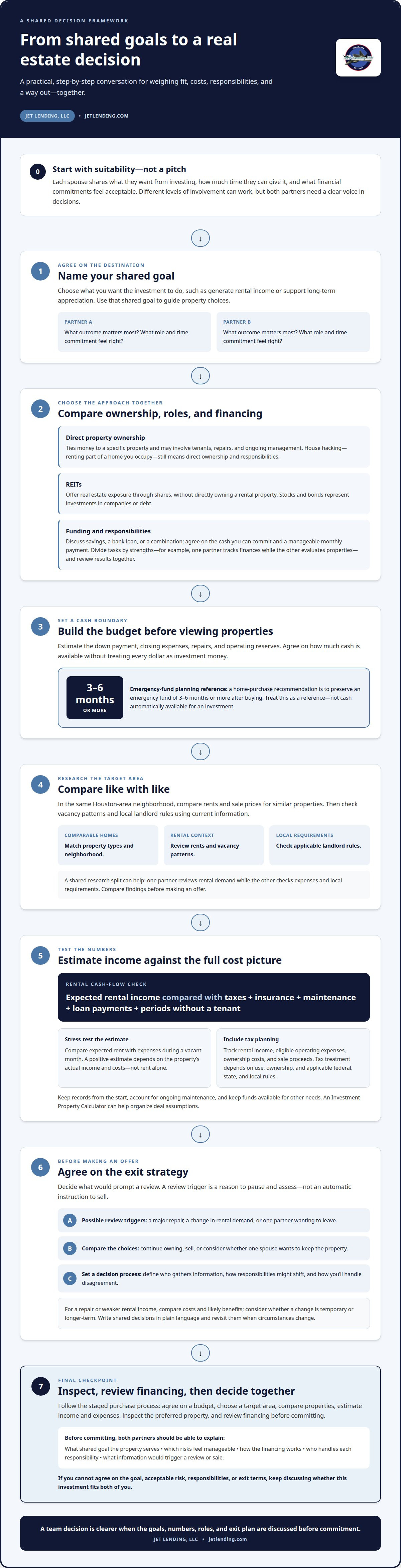
The goal isn’t to win your spouse over. It’s to find out whether real estate investing fits both of you. If you’re wondering how to convince a spouse to invest in real estate, start with an open conversation, not a sales pitch. Talk through what you both want, what risks feel manageable, and what would make you decide to sell.
It’s reasonable to feel excited about an opportunity and still want to protect your shared finances. Your spouse may need time to learn or may have concerns you haven’t considered. Approach the discussion as a team: clarify shared goals, compare risk tolerance, agree on how you’d finance an investment, and set an exit strategy before deciding. You’ll also consider whether to work together or divide responsibilities, and how to assess a property’s potential returns and costs. By the end, you’ll have a practical way to decide whether investing makes sense for both of you, without turning a financial conversation into a contest.
Start with a suitability check, not a pitch. Each spouse should describe what they want from an investment, how much time they can give it, and what financial commitments feel acceptable. One partner, for example, may prefer hands-on property management while the other wants a more passive role. Different preferences can work, but both need a clear voice in decisions.
Real estate differs from stocks, bonds, and REITs. Direct ownership ties your money to a specific property and may involve managing tenants and repairs. Stocks and bonds represent investments in companies or debt, while REITs offer exposure to real estate through shares, without directly owning a rental property.
Discuss financing before viewing properties. You might use savings, seek a bank loan, or combine approaches. Lenders assess borrowers and the property, while terms depend on the loan and your individual finances. Agree on how much cash you can commit, what monthly payment is manageable, and which partner will track the financing details.
Set a cash boundary, too. A home-purchase recommendation is to preserve an emergency fund of 3-6 months or more after buying. Treat that as a planning reference, not money automatically available for an investment. Estimate the down payment, closing expenses, repairs, and operating reserves before deciding what you can invest.
Test cash flow using realistic figures. Weigh rental income against property taxes, insurance, maintenance, loan payments, and periods without a tenant. For example, compare expected rent with expenses during a vacant month. A positive estimate depends on the property’s actual income and costs, not rent alone.
Include tax planning in the discussion. Track rental income, eligible operating expenses, ownership costs, and proceeds if you sell. Tax treatment depends on how the property is used and owned, as well as applicable federal, state, and local rules. Keep records from the start and discuss how taxes may affect your shared investment goals.
Research the market together. Compare rents and sale prices for similar properties in the same Houston-area neighborhood, then examine vacancy patterns and local landlord rules. Focus on comparable property types and current information. One partner can review rental demand while the other checks expenses and local requirements. Compare your findings before making an offer.
Use a staged purchase process: agree on a budget, choose a target area, compare properties, estimate income and expenses, inspect your preferred property, and review financing before committing. An Investment Property Calculator can help organize deal assumptions. If you want a lower-commitment route, consider REITs. House hacking, or renting part of a home you occupy, still involves direct property ownership and responsibilities.
Your roles don’t have to match. You might work side by side, run a business together, take separate roles in the industry, or have one spouse support the other without entering real estate. Agree in advance on how you’ll make decisions and handle disagreements. Keep communication open so both of you stay involved and informed as plans develop.
Set the financing approach together, including whether to use joint savings or bank loans. Then divide responsibilities according to each partner’s strengths: one might handle finances while the other evaluates properties, with both reviewing the results.
Before making an offer, agree on what would make you sell. “We’ll know when the time comes” leaves each spouse to define success differently. Instead, identify reasons to review the investment, such as a major repair, a change in rental demand, or one partner wanting to leave. A review trigger doesn’t force a sale. It gives you a shared point to pause, compare the property’s performance with your goals, and decide together.
Separate a review from a decision to sell. If a property needs substantial work, for example, compare the cost and likely benefit of repairs with selling it in its current condition. If rental income weakens, consider whether the cause is temporary or signals a longer-term change. Don’t rely on one disappointing month or a short-term market shift. Agree on what information to consider, who will gather it, and how you’ll decide.
Discuss possible outcomes before either spouse feels under pressure. You might continue owning the property, sell it, or consider whether one spouse wants to keep it. Each option affects you differently. Discuss who would take responsibility for the property, how you’d assess a proposed buyout, and what you’d do if you couldn’t agree. Don’t assume one spouse can simply take over without considering financing, ownership arrangements, and professional advice.
Plan for changes in your working relationship as well as changes in the property. If you manage a real estate business together, discuss what happens if one person no longer wants to participate or the relationship ends. Decide how responsibilities would shift, how ongoing work would be handled, and which decisions require both partners’ agreement. Keep the plan practical. A clear process can reduce uncertainty during a difficult transition.
Write down your shared decisions in plain language, then revisit them when circumstances change. Include reasons to review a sale, information you’ll compare, each person’s responsibilities, and a way to resolve disagreements. For example, you could agree to pause and review the property’s income, costs, condition, and market prospects together before acting. The plan should support a calm discussion, not prevent either spouse from considering new information.
An exit strategy also helps you test whether the investment suits both of you. If one spouse wants a defined way out and the other expects to hold indefinitely, discuss that difference before buying. You don’t need to predict every future event. The aim is to make the main choices together, before the pressure of an urgent sale.
Put your reason for investing into one shared sentence. For example: “We want rental income to support retirement while preserving cash for near-term needs.” This gives both spouses a test for future choices. If a property doesn’t serve the agreed purpose, pause before pursuing it. Shared goals might include financial independence, retirement savings, or funding children’s education. Name your top priority, then discuss how property could support it.
Be specific about the return you’re seeking. Long-term appreciation means focusing on potential growth in property value; rental income means prioritizing money from tenants. Portfolio diversification means adding real estate alongside other investments. These goals can overlap, but may lead to different property choices. A couple seeking rental income, for instance, may weigh expected rent more heavily, while appreciation-focused investors may prioritize a property’s long-term prospects.
Talk about timing as well as purpose. A mutually acceptable home-buying timeline can be 6-18 months, while a 5-year plan or a 10-year plan can help couples assess when homeownership may be reasonable. Those timeframes are planning prompts, not automatic deadlines for an investment purchase. Set a date to review progress, then identify what needs to be true before moving ahead, such as agreement on the goal and comfort with the commitment.
Keep near-term needs in view as you discuss long-term plans. Don’t automatically treat cash set aside for upcoming expenses as investment capital. Also consider how inflation may affect purchasing power over time. Separate funds mentally into near-term needs and long-range goals, then discuss how much flexibility you want to preserve before committing money to property.
Agree on how you’ll measure progress. For a rental-income goal, decide what to review, such as rental income and property expenses. For a retirement goal, connect the property decision to your broader retirement plans. You could set a shared milestone, such as completing property research or reviewing an investment’s performance together. Clear measures help you notice when the plan needs attention without mistaking activity for progress.
People asking how to convince a spouse to invest in real estate may focus on making the strongest case. A better approach is to understand what your spouse wants the investment to accomplish. If you’re considering how to convince a spouse to invest in real estate, begin with a goal you can both support, not a property you’re already attached to. Record the goal, time horizon, and trade-offs you both accept. If you don’t share a purpose, keep discussing options rather than forcing a purchase.
Assess risk tolerance by naming the losses, workload, and uncertainty each of you can accept, then match a property strategy to your shared goals. Discuss, for example, how a vacancy or unexpected repair would affect your finances and comfort. Talking openly about these concerns can help you find a compromise without dismissing either partner’s perspective.
Make the conversation specific. Each spouse can describe a financial outcome that would feel manageable and one that would feel stressful. Consider a property needing repairs, rental income falling, or property values declining. Ask what information would help you respond and whether you’d still support the investment if the short-term outlook worsened. These scenarios turn “I’m worried” into concerns you can examine together.
A market downturn can make investing difficult when partners have different risk tolerances. Don’t treat a lower price as an automatic opportunity or warning. Review the property’s expected income, condition, costs, and fit with your long-term plan. Distinguish short-term market losses from the longer-term purpose you agreed on, while considering how inflation may affect purchasing power over time.
Use research and education to fill gaps before deciding. Study how local rents and property values have changed, watch educational programs, or discuss market risks with a financial advisor. Then compare what you learn with the specific property under consideration. A spouse who wants more certainty may feel more comfortable evaluating documented assumptions than responding to a persuasive forecast.
Choose a property type that fits both partners’ comfort levels. One spouse may accept renovation work, while the other prefers a property requiring less hands-on attention. Discuss how each option affects time, costs, and potential income. If a possible repair or vacancy would create serious strain, reconsider the property or the level of financial exposure you’re willing to share.
Also compare an investment with other household priorities. A home purchase could mean delaying retirement by 5 to 10 years, so discuss how real estate fits alongside retirement savings and other plans. Keep the conversation tied to your own goals: identify which commitment matters most, what trade-off you’d accept, and what would make you pause.
End by writing down a shared decision rule. For example, agree not to proceed unless both partners understand the property’s risks, expected responsibilities, and effect on household plans. Revisit the rule when the market or your finances change. Risk tolerance isn’t about eliminating uncertainty; it’s about choosing an investment whose possible setbacks both spouses can live with.
Spouses investing in real estate should discuss their risk tolerance and choose properties accordingly. Open communication about goals and risk can help you reach a compromise. A shared rule can preserve both partners’ concerns instead of leaving one to accept a decision they don’t understand.
When considering investing during a market downturn, couples can use research, educational programs, or discussions with a financial advisor to better understand market risks. Weigh short-term market losses against long-term goals and consider how inflation may affect purchasing power.
Estimate returns from the property’s net performance, not rent alone. Start with expected rental income, then subtract operating expenses, financing costs, and periods without tenants. Property appreciation can increase its value over time, but it may not provide cash for current expenses. Compare projected income and costs with your shared goal, such as ongoing rental income or long-term growth.
Maintenance deserves its own budget line. One recommendation is to set aside 1-2% of a home’s value per year for maintenance. Treat this as a planning guide, then consider the property’s age, condition, and expected repairs. A roof issue or appliance replacement can change a month’s cash flow, so don’t count every dollar of rent as spendable income.
Build a property-level cash-flow worksheet before committing. List expected rent, property taxes, insurance, maintenance, loan payments, and vacancy periods. Compare what remains with your household’s expectations. If a unit sits empty, for example, rent stops while recurring expenses continue. A second scenario with lower rent or an unexpected repair can show whether the plan still fits your finances.
Potential returns also depend on the purchase price and the property’s performance after acquisition. Compare similar rentals in the same area, using realistic rent assumptions rather than the highest advertised figure. Review the property’s condition and likely upkeep before estimating profit. If values fall, your equity can shrink; if rent doesn’t cover costs, you may need household funds to support ownership.
Separate upfront needs from ongoing expenses. Buying requires cash for the down payment and transaction costs, while ownership brings recurring bills and repairs. Keep a reserve for unexpected maintenance and vacancies rather than putting every available dollar toward the purchase. Discuss which expenses you’d cover with rental income and which would require shared funds.
Review the numbers together before deciding. One spouse can prepare the income estimate while the other checks recurring costs and repair assumptions. Then compare the worksheet with your agreed investment goal and discuss which assumptions could change the result. This makes trade-offs visible and helps both partners understand how costs affect the expected return.
Jet Lending, LLC offers short-term loans for real estate investors considering a property purchase or investment project. Once you and your spouse agree on the property, financing approach, and risk limits, explore whether a short-term loan fits your plan. Include the loan’s terms and repayment obligations in your shared cash-flow review, alongside expected rent, operating expenses, and your exit strategy. The Investment Property Calculator can help you organize assumptions and examine how changing them affects a deal’s projected figures. Use those estimates as part of your discussion, not as a substitute for agreeing on the investment together. If you’re ready to explore financing for an investment property, contact Jet Lending, LLC.
Your next conversation doesn’t need to end with a purchase decision. Agree on one small step you can take together, such as reviewing a property example, learning about a financing approach, or setting a time to revisit the idea. A shared process gives both spouses room to ask questions and build confidence without pressure to decide before you’re ready.
The better question than how to convince a spouse to invest in real estate is whether you can develop a plan both of you genuinely support. If your views still differ, use that difference to identify what needs more discussion. A thoughtful pause can protect your partnership and help you make a clearer decision.
Start with an honest conversation, stay curious about each other’s concerns, and take the next step as a team.
The main risks include debt obligations, unexpected repairs, vacancies, and falling property values. Leverage can magnify the effect of lower income because loan payments remain due even when rent falls. A major repair can strain available cash, while a downturn may make selling harder or reduce the property’s value. Couples should also consider whether owning a single property concentrates too much of their investment in one asset.
Before buying, decide who will handle tenant communication, maintenance decisions, records, and payments. Agree on how to approve unexpected expenses and what happens if one spouse can’t manage their assigned tasks. Discuss how much time each partner can contribute, where you’ll keep shared investment records, and how you’ll respond if the property needs attention while you’re traveling or handling other commitments. Make sure both spouses can explain the plan in their own words.
Tags:

A long-term rental loan may be the wrong first move for a Cypress property that needs work. The right investment property financing Cypress TX investors pursue depends on the deal’s timeline and...

What if you could make a strong Houston offer without waiting for a bank’s full approval process? For investors competing with cash buyers, bridge loans for real estate investors Houston can provide...

What if the financing that helps you secure a Houston investment also puts pressure on your exit plan? A short-term loan can support an acquisition or rehabilitation project, but the fit depends on...