
Written By: Stephanie Rojas | November 27, 2026
Time to Read 11 Minutes
Luxury flips need a funding plan that accounts for both the purchase and renovation, not just the home’s price. Houston luxury home flip financing often uses short-term, asset-backed loans, with the property and project details helping shape the loan structure. A fix-and-flip loan is designed to fund an investment property purchase and improvements, with repayment planned around the project’s exit.
Focus on the terms before committing: the loan amount, borrower qualifications, renovation budget, and time needed to complete and sell the home all affect the funding plan. For a high-value property, gaps in the budget or timeline can change how much capital the project needs.
This guide explains how Houston flip loans are structured, what lenders consider when assessing a borrower and property, and how hard money financing can fit a luxury renovation. It also covers project costs to include when planning funding from purchase through resale.
Houston offers investors properties across a wide range of price points. A market snapshot dated November 27, 2026, reported an average of 106 days on market. These examples show why investors need to assess each property individually, rather than assume one financing structure fits every flip.
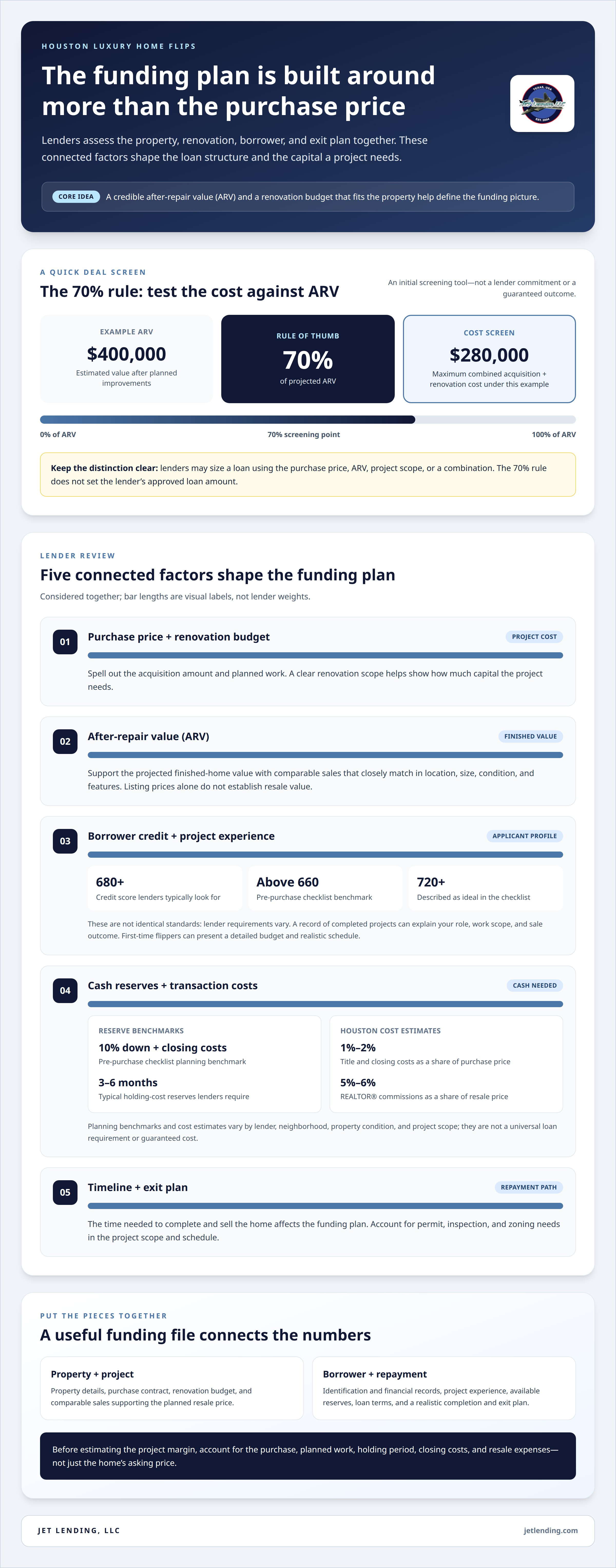
Lenders compare the purchase price, renovation budget, and projected after-repair value (ARV), an estimate of the property’s value after planned improvements. Comparable sales help support that estimate. Relevant properties should closely match in location, size, condition, and features. A polished luxury home in one Houston neighborhood may not be a useful comparison for a home in another area or one needing extensive work. The valuation should reflect the finished home, not just its current condition or asking price.
The 70% rule offers one initial way to test a deal. For a Houston home with a $400,000 ARV, acquisition and renovation costs should total no more than $280,000 under this rule. That calculation is a screening tool, not a lender commitment. Lenders may set their loan amount using the purchase price, ARV, project scope, or a combination. A strong Houston luxury home flip financing plan therefore depends on a credible ARV and a renovation budget that fits the property.
When evaluating a Houston-area fix-and-flip lender, compare how each assesses these factors. Look for clear explanations of valuation, eligible renovation costs, loan term, repayment structure, and borrower documentation. An ARV estimate should be grounded in comparable sales, and the project review should distinguish planned work from the home’s current condition. Clear terms make it easier to estimate the funding gap and project timeline.
Luxury purchases can also raise the question of a jumbo loan. A jumbo mortgage applies when the loan amount exceeds the conforming loan limit for Harris County. Jumbo lenders generally scrutinize reserves, income documentation, and appraisals more closely than conforming-loan lenders. That classification does not automatically determine a fix-and-flip loan’s structure. Compare the loan’s purpose and repayment terms with the project plan, especially when the purchase amount is high. The right comparison connects valuation, renovation scope, borrower profile, and exit plan.
Houston neighborhood sale prices show why loan sizing must match the specific property. These figures offer neighborhood context, not a valuation for a particular luxury home. A lender weighs the subject property’s condition, location, comparable sales, purchase price, and planned improvements.
Loan-to-purchase-price and loan-to-after-repair-value calculations answer different questions. The purchase-price figure relates funding to the acquisition amount; the ARV figure relates the loan to the estimated value after work. That example illustrates how lenders may consider both current project costs and projected finished value.
For luxury properties, lenders review the renovation scope alongside the expected resale price. The budget should clearly describe planned work, and comparable sales should support the projected finished value. Listing prices provide context, but they do not establish what a renovated property will sell for.
Permit, inspection, and zoning needs depend on the property and proposed renovation. Include these steps when setting the project scope and timeline, rather than treating them as an afterthought.
Typical purchase and resale costs vary by neighborhood, property condition, and project scope. Houston flip title and closing costs are estimated at 1% to 2% of purchase price. Investors may also pay 5% to 6% of resale price in REALTOR® commissions.
Use these figures to frame the funding analysis, not as a guaranteed outcome. A lender compares the proposed purchase, renovation budget, comparable sales, and planned resale price to assess whether financing fits the deal. For a Houston property, distinguish listing prices from completed-sale evidence and account for transaction costs before estimating the projected margin. This helps separate an appealing asking price from a workable investment.
Houston flip lenders weigh borrower credit, project experience, available cash, and property details together. Prepare a clear financing file before submitting a luxury-home proposal.
Houston fix-and-flip lenders typically look for credit scores of 680 or higher. A pre-purchase checklist uses a score above 660 as a benchmark, with 720 or higher described as ideal. These figures aren’t identical standards: lender requirements vary, and a stronger score may support a stronger overall application.
Experience helps show how you will manage the renovation and resale plan. Organize a concise record of completed investment projects, including your role, work scope, and sale outcome. For a first flip, present a detailed project budget and realistic schedule. Lenders can assess the plan alongside your credit and financial profile.
For an application, assemble borrower identification and financial records, property details, a purchase contract, and renovation budget. Include the planned resale price and supporting comparable sales when available. These materials connect the requested loan to the property and proposed work. Keep figures consistent across documents, especially purchase terms, project costs, and the expected exit.
How much cash is needed? A pre-purchase checklist recommends reserves covering a 10% down payment plus closing costs, while lenders typically require reserves equal to 3 to 6 months of holding costs. These are planning benchmarks, not one universal down-payment requirement for every Houston luxury flip.
Separate closing funds from cash set aside for the project’s carrying period. A down payment does not cover loan payments or other holding expenses. For example, a project that takes longer than planned may require reserves beyond the amount needed to close. Show how available cash supports both the purchase and project timeline.
Make the application easy to assess by grouping documents into three parts: borrower finances, property acquisition, and renovation plan. Provide financial statements and account records to show available funds, add the purchase contract and property information, then include the itemized work plan and projected resale figure. Lenders can compare these materials with the property valuation and proposed loan structure.
Before submitting, reconcile the budget with the work scope and timeline. If the plan includes major updates to a luxury property, show how each cost supports the expected finished condition. A lender needs to understand both the borrower’s capacity and the project’s numbers. Clear records, relevant experience, and reserves for 3 to 6 months of holding costs make those factors easier to evaluate together.
A Houston flip’s financing plan must cover more than the purchase and renovation. Taxes, insurance, loan holding costs, utilities, closing charges, and resale expenses all affect the capital required. Include each category in the project forecast before evaluating the expected margin. An omitted cost can reduce cash available for later work or repayment.
Houston property taxes, insurance, and flood exposure can change carrying costs. The property’s assessed value and local tax rates affect tax projections, while insurance adds another holding expense. Property-specific flood exposure can also affect insurance planning. Include these factors in the financing model before estimating the project’s cash needs.
The page’s Houston estimate puts property taxes at about 2.2% of assessed value. That makes the specific property’s tax burden important, not just the neighborhood’s sale prices. Use the assessed value and applicable local rates when projecting the holding period.
Treat the combined estimate as a planning reference, not a universal amount for every luxury property. The home’s assessed value and insurance needs shape its carrying budget. Include flood exposure in that review because insurance costs affect how much cash remains available during renovations.
A longer project can extend the period in which financing costs accrue. Model the schedule from acquisition through renovation and resale, accounting for the time needed to complete each stage. This gives the funding plan a more realistic view of how long capital will remain committed.
Closing costs also need their own line in the project budget. Houston flip title and closing costs are estimated at 1% to 2% of purchase price. Luxury deals require the same budgeting discipline, with the purchase amount and transaction details informing the final calculation.
Resale expenses affect the amount available to repay financing after a sale. Houston fix-and-flip investors may pay 5% to 6% of the resale price in REALTOR® commissions. Calculate that expense against the planned resale figure, rather than treating the gross sale price as proceeds. Then account for remaining project obligations before judging the expected return.
List these costs alongside renovation expenses, not as general contingencies. A useful forecast separates purchase, construction, taxes, insurance, financing, closing, and resale costs. This breakdown reveals which expenses change with time, assessed value, or planned work.
Hard money loans use the investment property and project as key parts of the financing decision. Houston fix-and-flip loans typically have terms of 6 to 18 months, matching the short-term nature of a purchase, renovation, and resale plan. Houston lenders may finance up to 100% of documented renovation costs. The approved amount still depends on the property and loan structure.
Interest and upfront points affect the total borrowing cost. Houston fix-and-flip loan interest rates are usually 8% to 12%, and upfront points or fees of 2 to 3 points are common. Points are upfront loan charges calculated in relation to the loan amount. Include both the interest and upfront charges in the financing model, rather than focusing only on the loan amount.
Funding terms can shape renovation cash flow. If a lender finances documented renovation costs, the project budget should clearly describe the planned work and associated costs. Tie each improvement to the property’s condition and intended resale. A defined scope aligns the funding request, work plan, and expected exit. Keep contingency planning separate from amounts included in the documented renovation budget.
Compare a hard money loan’s term with the full project timeline. Acquisition, renovation, marketing, and closing all take time. A 6-month term leaves less room for delay than an 18-month term. Model the expected schedule against the maturity date, then consider how an extended renovation or slower resale could affect repayment. The exit plan should explain how the outstanding loan will be repaid.
The main financing pitfalls are underestimating renovation costs, overestimating after-repair value, and running short of time before repayment. On a luxury property, an expensive scope change can increase funding needs, while a lower resale price can reduce expected proceeds. Interest and upfront points also affect the project’s margin, so include them alongside purchase, holding, and resale expenses.
Before selecting terms, compare the amount available for purchase with documented renovation funding, rate, points, term, and repayment plan. A project with extensive work and a tight resale schedule, for example, needs a different timeline assessment from one involving a lighter renovation. Review the full funding structure against the property valuation and budget. The clearest plan connects the loan’s maturity date to a realistic sale and repayment path.
Jet Lending, LLC offers short-term, asset-backed loans for real estate investors planning a purchase, renovation, and resale. Consider this financing when you want to discuss how the property, project budget, and repayment strategy fit together. Jet Lending’s Investment Property Calculator can also help you assess deal assumptions as you plan.
Bring the key details together: purchase terms, renovation scope, projected resale value, and expected timeline. This context frames financing questions around your specific deal. For Houston flip financing, start with the numbers behind your project and the outcome you are targeting.
Contact Jet Lending, LLC to discuss your investment financing needs.
A sound plan for Houston luxury home flip financing connects each funding decision to the property’s intended outcome. Before moving ahead, make sure the purchase, renovation scope, and resale strategy work together. Keep assumptions clear and revisit them if the project changes. This gives you a stronger basis for deciding how much capital to commit and how financing fits your investment goals.
The next step is a focused financing conversation. Share the property information, renovation plan, and expected exit so the discussion centers on your actual deal. Jet Lending, LLC’s investment-focused resources can help you move from general research toward a practical funding plan.
Every well-planned project begins with a clear next move. Take yours with confidence.
A fix-and-flip loan is short-term financing for buying and renovating an investment property before resale. It is asset-backed, so the property and project are central to the financing decision. A lender may review the home’s current condition, planned work, and expected sale as connected parts of one deal. Investors should align repayment with the intended exit, usually the sale of the renovated property.
Houston investors may consider short-term hard money, private or bridge financing, and bank financing, including jumbo mortgages for loans above Harris County’s conforming limit. Each option has a different fit: short-term financing is structured around an investment project, while a jumbo mortgage follows mortgage underwriting. For Houston luxury home flip financing, compare purpose, repayment timeline, collateral review, and documentation before choosing a structure.
Houston fix-and-flip loan rates are usually 8% to 12%, with upfront points or fees of 2 to 3 points commonly reported. Typical loan terms range from 6 to 18 months. Lenders may finance up to 90% of a property’s purchase price and up to 100% of documented renovation costs. These are distinct measures, not a single combined loan-to-cost limit; review how each applies to the deal.
A lender can assess the project timeline, property security, renovation funding needs, borrower profile, and repayment plan against a financing structure. A short renovation and resale plan may call for different terms from a longer hold. For bank or jumbo financing, the loan amount’s relation to Harris County’s conforming limit also matters. Compare total obligations and maturity timing, not just the initial amount.
Look for a lender that explains how it evaluates high-value properties, renovation scope, comparable sales, and repayment. Request clear written terms covering the loan amount, interest, points, maturity date, and conditions that affect funding. Assess whether the lender’s process fits the project timeline and documentation. For a luxury home, a precise valuation method matters because unusual features can make comparable properties harder to select.
Lenders compare the proposed finished value with relevant sales, the property’s current condition, and the work needed to reach that condition. A budget should connect each major renovation item to the planned result, while the exit plan should explain how the investor expects to repay the loan. If the resale estimate relies on properties in different locations or with different features, scrutinize the valuation more closely.
Tags:

What if the financing that gets you the keys leaves too little cash to finish the renovation? Learning how to finance a house flip in Houston means looking beyond the purchase price. Rehab costs,...

More flips do not automatically mean more profit. The practical answer to how to scale a house flipping business in Houston is to grow only as fast as your deal analysis, financing, contractor...

A foreclosure deal can look like a bargain until the funding timeline, repair budget, or exit plan stops adding up. The key question isn’t simply whether hard money for foreclosure purchases Houston...