
Written By: Stephanie Rojas | October 26, 2026
Time to Read 13 Minutes
A strong Houston home offer needs more than confidence; it needs clear evidence that the funds are available. Getting proof of funds for a real estate offer in Houston means showing the seller that you or your purchasing entity can access enough money to complete the purchase and cover expected closing costs. A recent bank statement or a letter from a financial institution can serve as proof of funds. A mortgage preapproval, by contrast, describes expected loan financing rather than cash already available. A proof-of-funds letter confirms financial capacity, but it doesn’t commit a bank to lend or guarantee the transaction.
That distinction matters even more when an offer involves a higher-value property, where sellers may want clearer documentation of the funds behind the transaction. You’ll learn what a proof-of-funds letter should show, which documents may count, how to protect sensitive account details, and when a seller may request updated evidence. We’ll also explain how proof of funds differs from mortgage preapproval, so you can understand what each document tells a seller and prepare a more complete Houston offer.
A proof-of-funds letter, or POF letter, documents money available for a property purchase. Getting proof of funds for a real estate offer in Houston gives sellers evidence that the buyer or purchasing entity can complete the transaction.
To request a bank proof-of-funds letter, ask your financial institution to document accessible funds for a specific purchase. A clear, current letter helps a seller assess the offer without seeing every detail of your finances.
Contact your bank and identify the buyer or purchasing entity, the property offer, and the amount you need to demonstrate. Ask the bank to include its name, the date, the account holder, and the available balance. A request may take a few days. If funds are spread across accounts, consolidating them first can help, since bank transfers can also take several days.
A POF letter confirms financial capacity based on the funds available when the institution prepares it. It doesn’t commit the bank to lend or guarantee that the purchase will close.
A credible letter identifies the buyer or purchasing entity and shows a balance sufficient for the transaction. It typically fits on one page and is often dated when the offer is made. It should include the bank’s letterhead, date, buyer or entity name, available balance, confirmation that funds are available, and an authorized representative’s details.
A bank statement can also document the balance. Redact sensitive account details only if the buyer’s name, institution, statement date, and available balance remain visible. These details connect the evidence to the person or entity making the offer.
Proof of funds should show enough available assets to cover a cash purchase and expected closing costs. There’s no single proof-of-funds amount for earnest money, the option fee, and closing costs. The offer terms and total cash needed determine what to document.
Under Paragraph 5 of the Texas contract discussed, earnest money and the option fee are due to the title company within three days of the effective date, according to the Texas Real Estate Commission. The Texas resale contract doesn’t require an all-cash buyer to provide proof of funds or set a deadline or remedy for failing to provide it. A seller may still request documentation before accepting a cash offer.
Fake or altered letters can mislead sellers about a buyer’s ability to close. Compare the buyer’s name, issuing institution, date, and balance, then verify the letter directly with the bank using contact details obtained independently. For buyers getting proof of funds for a real estate offer in Houston, clear ownership and current records help sellers assess the evidence.
For a Houston offer, sellers may accept proof dated within the previous 30 to 60 days, but some Texas sellers request a bank letter dated within 30 days. The Texas resale contract doesn’t require an all-cash buyer to provide proof of funds or set a deadline for it; a lender may request recent statements to confirm funds for remaining purchase costs.
Buyers typically provide proof of funds with an offer or when a seller or agent requests it. Sharing it before acceptance can show that the buyer has accessible assets, particularly for a cash offer.
If the offer is submitted without the document, a buyer may be asked to provide it within a day or two. After acceptance, sellers or agents may request updated proof within 24-48 hours. Keep the document ready alongside offer materials so a request doesn’t delay review or distract from planning the move.
Statement recency means how recently the financial institution recorded the balance shown on the proof. A seller can accept a statement dated no more than 30 to 60 days ago, while a Texas seller can request a bank-issued letter dated within the last 30 days.
For a Houston offer, use the most current statement available and compare its date with the seller’s requested standard. If the balance has changed since the statement was issued, an updated letter can show the funds available when the offer is considered. This is especially useful when money has moved between accounts or recently become accessible.
The document should identify the buyer or purchasing entity and show enough available assets for the cash portion of the purchase and expected closing costs. Funds generally need to be liquid or easily converted to cash. For example, selling investments and transferring the proceeds from a brokerage account may take time, so its displayed value may not equal money immediately available for closing.
Gift funds can support proof of funds once deposited and accessible, as can an inheritance available to the buyer. A buyer making a cash down payment may be asked to clarify the source of the funds. A real estate agent can help coordinate when to provide the document, but the evidence should clearly show accessible funds.
There isn’t a single Houston-area title-company rule in the Texas resale contract requiring every cash buyer to submit proof. A lender may separately request statements to confirm the buyer can cover remaining costs. The contract’s Paragraph 3A defines the cash portion of the sales price as excluding borrowed funds and proceeds from selling other property, except as disclosed in the contract. Keep those distinctions clear as you prepare for closing costs, transactions, and moving plans.
A Houston seller or lender can review several types of documents to assess whether funds are available for a purchase. The strongest choice depends on the account, how quickly assets can be accessed, and what the reviewer needs to verify.
A recent bank statement is a common option because it shows the account holder and balance. A money market balance document or a letter from a financial institution can also show available funds. Certified financial statements may give a broader view by showing assets, liabilities, and net worth.
Bank statements used instead of an official funds letter typically cover the previous 3-6 months of transactions. A seller can accept a statement dated no more than 30 to 60 days ago. Lenders may request recent statements from the previous 30-90 days, depending on their review of the purchase costs.
Keep the buyer’s name, institution, statement date, and available balance visible. You can redact sensitive account details while preserving those items. For example, a statement with the account number concealed can still show whether the funds belong to the named buyer.
Sellers may request proof before accepting a cash offer to see whether the buyer has money available to complete the purchase. A document showing accessible funds helps distinguish a supported offer from one relying on assets that may not be readily converted into cash.
That distinction matters for investments held outside a bank account. A buyer may own securities or other assets, but their value alone doesn’t show that sale proceeds are ready for closing. Funds used as proof generally need to be liquid or easily converted to cash. Deposited gift funds and accessible inheritance funds may also qualify.
A lender can request proof to confirm that a buyer can cover remaining purchase costs. For a transaction above $1M, sophisticated sellers and their counsel may request a recent bank statement or direct verification with the issuing banker. These added checks can clarify the source and accessibility of funds before the parties proceed.
Choose the document that most directly shows ownership and available balance. If a bank statement lists several accounts or has unclear deposits, an institution letter or certified financial statement may present the financial picture more clearly. This helps sellers and lenders assess the evidence without relying on a balance screenshot alone.
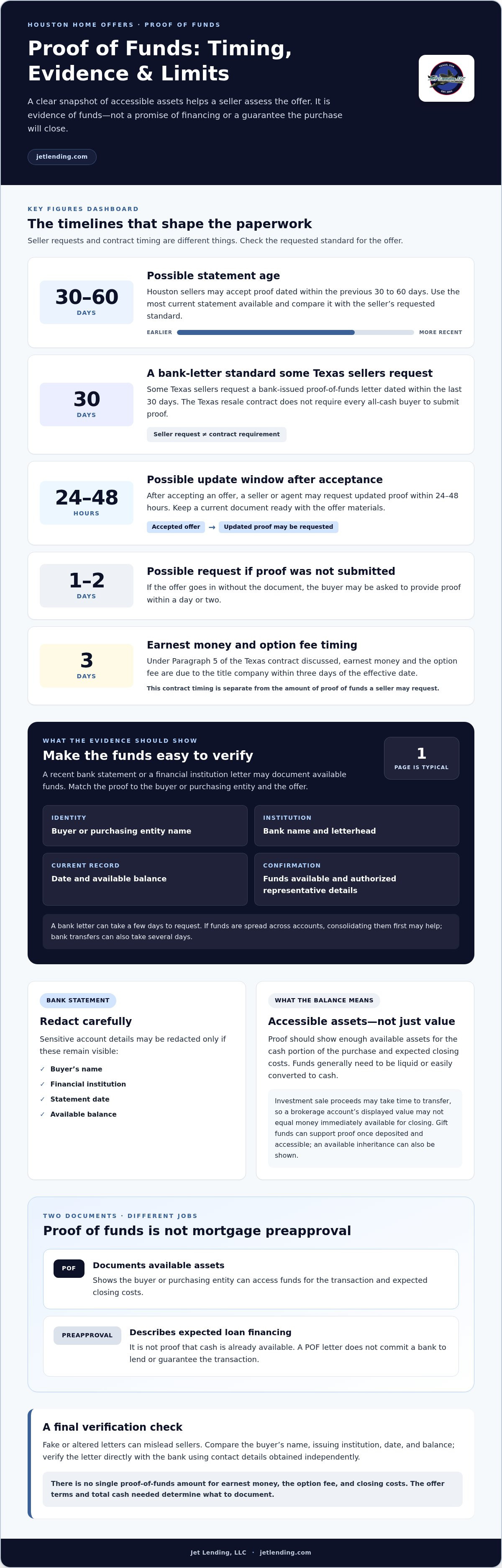
Proof of funds and mortgage preapproval answer different questions in a Houston home purchase. One documents assets already available; the other describes financing a lender expects to provide. A seller may request both when an offer combines a mortgage with cash for the down payment and closing costs.
A proof-of-funds document supports the buyer’s claim that money is accessible for the transaction. It may show funds for an all-cash purchase or the buyer’s share of a mortgage-financed purchase. The document might be a bank statement or a financial institution letter. Its purpose is to show available assets, not to assess the buyer’s ability to repay a loan.
A mortgage preapproval letter serves a different role. It describes the financing a lender expects to provide, but it doesn’t document the buyer’s available bank balance. A seller may request a preapproval letter alongside proof of funds to see both the proposed loan financing and the cash available for remaining costs.
Consider a buyer making a mortgage-backed offer. The preapproval shows the loan portion, while a funds document can show whether the buyer has money for the down payment and other purchase costs. For context, a mortgage-financed purchase ideally has a 20% down payment, and closing costs are usually 3%-4% of the home price. These figures describe general purchase planning, not a lender’s individual approval decision.
For an all-cash offer, the buyer’s share of the transaction is 100%. A preapproval letter alone doesn’t show those funds are available. A seller may therefore request proof before accepting the offer, even though the Texas resale contract doesn’t require an all-cash buyer to provide it. A current document that identifies the buyer and shows accessible assets addresses that specific question.
Keep the two documents aligned. The names and purchasing entity should match across the offer, statement, and preapproval letter. If a lender requests proof of funds, it may use the documents to confirm the buyer can cover remaining costs. Sellers may also request updated proof after acceptance, so make sure the statement reflects funds available for the purchase rather than an outdated balance.
A higher-value Houston offer can draw closer scrutiny because the seller needs confidence that the buyer can fund the transaction. For U.S. real estate transactions above $1M, sophisticated sellers and their counsel may request a recent bank statement or direct verification with the issuing banker. Clear documentation helps show who controls the funds and whether they can be accessed for closing.
Start with the full funding picture, not just one account’s headline balance. A bank statement should identify the buyer or purchasing entity and show available funds. If assets are spread across institutions, documents can clarify which balances are liquid and how the buyer plans to access them. Funds generally need to be liquid or easily converted to cash; an investment’s displayed value alone may not show that proceeds are ready for closing.
For a complex offer, organize the evidence around the transaction. Match buyer names across the purchase offer and financial documents. Make sure the statement date is clear and the balance reflects funds currently available. If a financial institution confirms assets through a letter, its name and the buyer’s identifying details should be visible. Redact sensitive account information without hiding ownership, institution, date, or balance.
A seller may also seek direct verification with the issuing banker, especially for a higher-value offer. This can help confirm that a statement is genuine and the balance belongs to the named buyer. A screenshot without institution details, an outdated statement, or a balance that cannot be tied to the buyer may leave questions unanswered. Keep verification focused on the amount and accessibility needed for the offer.
Funds held across accounts can create timing challenges. Bank transfers can take several days, so account for that when preparing an offer and planning to close. If funds include a documented gift or accessible inheritance, the evidence should show that the money has been deposited or is available. Sellers may also weigh the closing timeline, contingencies, earnest money, inspection terms, and overall contract strength. Proof of funds supports one part of that assessment, not the whole contract.
For investors comparing a property’s numbers before committing funds, an investment property calculator can support deal analysis. Use the results alongside current, liquid-funds documentation so the planned purchase and the available balance tell a consistent story.
A practical takeaway: for offers above $1M, prepare direct, buyer-linked evidence and be ready to clarify how funds will reach closing. A strong balance matters, but clear ownership, access, and timing make the documentation more useful to a seller.
Jet Lending offers short-term loans for real estate investors purchasing or improving investment properties. If proof of funds has clarified the cash available for your Houston offer and you’re considering financing for the investment, explore whether this type of loan fits your plans. A loan is not a substitute for proof of funds or mortgage preapproval, so make sure your documents reflect the funding structure in your offer.
Use Jet Lending’s Investment Property Calculator to support your deal analysis. Comparing projected figures with your available capital can help you understand how financing fits into the purchase before moving forward.
Visit Jet Lending’s website to explore its investor financing and property analysis resources.
Getting proof of funds for a real estate offer in Houston is one part of a larger investment decision. Before moving forward, consider how the property fits your acquisition goals, available capital, and plans for the asset. A well-prepared offer connects the opportunity you’re pursuing with a clear financing strategy.
Give yourself room to make that decision deliberately. Review the property’s numbers, consider how the purchase fits your investment approach, and decide what support would help you proceed. If financing is part of your plan, Jet Lending offers short-term loans for real estate investors and an Investment Property Calculator for deal analysis.
Take each step with a clear plan, then move forward with confidence in the opportunity you choose.
Request documentation that identifies the buyer or purchasing entity and shows funds available for the purchase. For a Houston cash offer, compare the name on the document with the name on the contract, then review the date and balance. If the evidence is a screenshot or ownership is unclear, request a clearer record. Direct verification with the issuing financial institution can help establish that the document is genuine.
Funds qualify when they belong to the buyer and are liquid or easily converted to cash for the transaction. Bank deposits and money market balances can show accessible funds. Documented gift money qualifies once deposited and accessible; inheritance funds qualify when available to the buyer. Assets that must be sold or transferred before use need supporting records that clarify how the buyer will access the money.
Proof of funds helps a seller assess whether a cash buyer can complete the purchase. It can show whether the buyer has money available, rather than relying on an unsupported claim or assets that cannot be accessed promptly. For a Houston seller comparing offers, this information provides context about the buyer’s financial readiness. It doesn’t replace the purchase contract or guarantee that closing will occur.
A Houston offer can use a bank statement, a financial institution letter, a money market balance document, or a certified financial statement. Choose evidence that clearly connects the funds to the buyer named in the offer. For example, if an entity is purchasing the property, the documentation should identify that entity or make its relationship to the funds clear. The seller evaluates whether the evidence supports the proposed purchase.
Texas buyers can present a recent bank statement, a bank-issued funds letter, a money market balance document, or a certified financial statement. The document should make the account holder and available assets easy to identify. If funds are held in separate accounts, provide records that clearly show the relevant balances together. A seller can request a particular format when evaluating an offer.
No. A preapproval letter describes mortgage financing, while proof of funds documents assets available to the buyer. For example, a buyer financing an investment property might provide a preapproval letter for the loan and separate evidence of cash for other purchase costs. A cash buyer’s preapproval alone doesn’t show money available for the full purchase. Keep the documents distinct so the seller can understand each funding source.
Ask the financial institution holding the assets for documentation that identifies the account holder and shows the available balance. State whether the buyer or a purchasing entity is making the offer so the record aligns with the contract. For brokerage-held assets, obtain a current account statement showing ownership and balance. If the funds must be sold or transferred before closing, plan for those steps when presenting them.
Include the buyer’s name, financial institution, statement date, and available balance. A letter can also confirm that funds are available, making its purpose clear to the seller. Redact sensitive account details, such as a full account number, while keeping the required identifying information visible. For a Houston offer made by an entity, make sure the buyer name on the document can be matched to the purchasing entity.
Tags:

A Houston flip can spend no more than $700,000 in total under the 70% rule when its after-repair value is $1 million. If repairs are budgeted at $50,000, that puts the purchase price at no more than...

What if the document that delays your Houston flip is the one you assumed someone else had handled? Title issues, liens, permit questions, financing conditions, or resale disclosures can surface at...

What if the financing that gets you the keys leaves too little cash to finish the renovation? Learning how to finance a house flip in Houston means looking beyond the purchase price. Rehab costs,...