
Written By: Stephanie Rojas | November 02, 2026
Time to Read 13 Minutes
A property's after-repair value can shape a flip before repairs begin. An arv calculator estimates what the property could be worth after renovation by comparing it with similar, renovated homes. To estimate a maximum offer, apply the 70% rule: multiply the ARV by 0.70, then subtract repair costs. For example, a property with a $300,000 ARV and $40,000 in repairs has a suggested maximum offer of about $170,000.
That gives you a useful starting point, but the estimate is only as strong as the comparable sales and renovation assumptions behind it. Use this guide to understand how ARV works, what information to enter into a calculator, and how to use the 70% rule when assessing a deal. You’ll also see why a calculator’s result is a planning tool, not a substitute for looking closely at the property, its repair needs, and the local market.
Estimate ARV by reviewing renovated comparable sales, then calculating the value the property could reach after repairs. In Houston, neighborhood-level market conditions matter: choose sales that reflect the same local market and the likely value of the finished property.
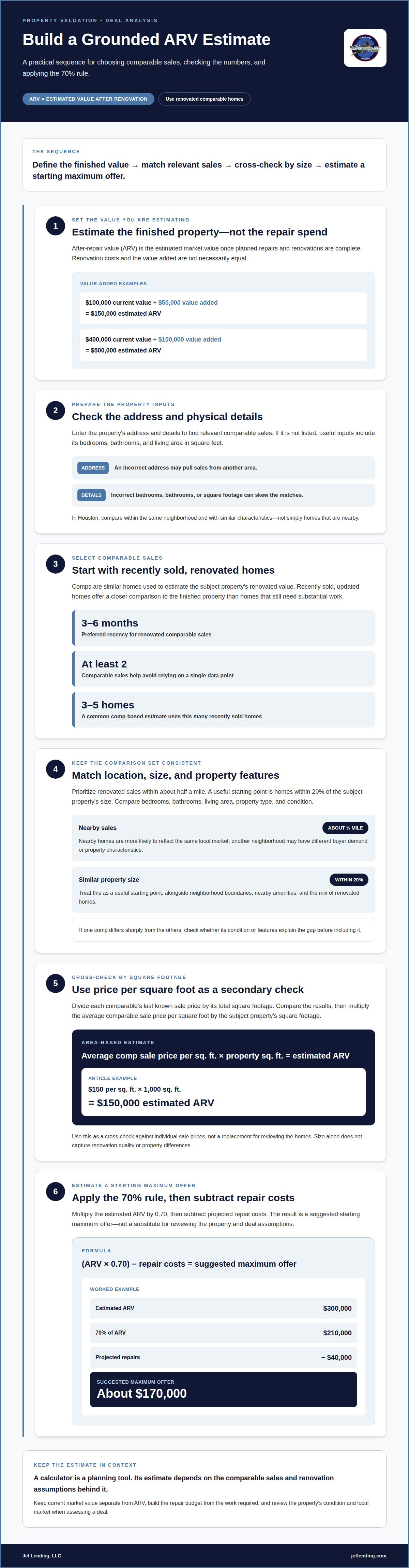
ARV estimates a property's value after renovations, not the amount the work will add. Renovation costs and increased market value are not necessarily equal.
For example, a property currently worth $100,000 that gains $50,000 in value after renovation has an estimated ARV of $150,000. Another property worth $400,000 with renovations adding $100,000 in value reaches an estimated ARV of $500,000. Focus on the value added, rather than simply adding the renovation budget to today's value.
Enter the property's address and physical details to find relevant comparable sales. If the property is not listed, useful inputs include its number of bedrooms and bathrooms and its living area in square feet.
Check the details before calculating. An incorrect address may pull sales from another area, while inaccurate bedroom, bathroom, or square-footage information can skew the matches. In Houston, compare properties within the same neighborhood and with similar characteristics, not just homes nearby.
Comparable properties, or “comps,” are similar homes used to estimate the subject property's renovated value. Choose renovated homes that sold within the last 3 to 6 months, since their sale prices reflect recent buyer activity more closely than older transactions.
Use at least two comparable sales to avoid relying on a single data point. A common comp-based estimate uses 3 to 5 recently sold homes. Compare condition as well as size: an updated home is more relevant to a post-renovation estimate than one that still needs substantial work.
Keep the comparison set consistent. Similar bedrooms, bathrooms, living area, and property type make sale prices more useful. If one comparable differs sharply from the others, check whether its condition or features explain the gap before including it.
An area-based method estimates ARV by multiplying the property's square footage by the average comparable sale price per square foot. Calculate each comparable's price per square foot by dividing its last known sale price by its total square footage, then compare the results.
For example, an average of $150 per square foot applied to a 1,000-square-foot property gives an estimated ARV of $150,000. Treat this as a cross-check against comparable sale prices, not a replacement for reviewing individual homes. Size alone doesn't capture renovation quality or property differences.
Prioritize renovated sales within about half a mile of the property. Nearby homes are more likely to reflect the same local market, while sales from another neighborhood may represent different buyer demand or property characteristics.
Compare square footage closely. A useful starting point is homes within 20% of the subject property's size. Local conditions also influence which comps fit: neighborhood boundaries, nearby amenities, and the mix of renovated homes can affect buyer interest. An appraisal similarly depends on relevant property evidence, so a clear, well-matched set of sales strengthens the estimate.
Use ARV to compare a property's potential resale value with its purchase and renovation needs. ARV estimates value after repairs; market value reflects the property's current condition. This distinction helps investors assess whether a fix-and-flip may justify the capital involved.
After-repair value, or ARV, is the estimated market value of a property once planned repairs and renovations are complete. It focuses on the likely value of the finished home, not its current condition or the amount spent on work.
An ARV calculator uses comparable sales to estimate that future value. Recently sold, renovated properties show what buyers have paid for finished homes with similar characteristics. The estimate can support deal analysis, but it does not mean each renovation dollar will add the same amount to resale value.
For example, a property currently valued at $200,000 could have an ARV of $275,000 if its renovation is expected to add $75,000 in value. The renovation budget in that example is $60,000. Keep the expected value added separate from the repair expense: one informs resale potential, while the other determines how much capital the work requires.
Market value reflects a property's current condition; ARV reflects its projected value after renovation. A worn kitchen or unfinished bathroom may weigh on the current estimate, while a renovated version may compare more closely with updated homes.
This distinction helps avoid a common budgeting error: treating the after-repair estimate as the property's present value. Use its current condition to assess the acquisition, then use renovated comparables to estimate resale value after the work. In Houston, neighborhood-level buyer demand and the quality of nearby renovated sales can affect that comparison.
Build the repair budget from the work required, rather than assuming the calculator's ARV result covers construction. List each project, estimate its scope, and total the costs. For example, repairs covering 500 square feet at $50 per square foot amount to $25,000.
Then compare the repair total with the property's estimated resale value and purchase price. A $300,000 ARV and $40,000 in repairs produce a suggested maximum offer of about $170,000 under the 70% rule. That calculation offers a screening point, not a full project budget. The repair scope, sale assumptions, and other deal expenses all affect how much capital remains available.
A separate example shows why offer limits matter: a property with a $100,000 value and $50,000 in renovations could yield $45,000 in profit and a 30% ROI after an $80,000 maximum bid. Use an investment property calculator to assess the broader deal alongside the ARV estimate.
Separate the estimated resale value from the offer calculation. Comparable renovated sales help estimate ARV; the 70% rule then uses ARV and repair costs to estimate a maximum offer. Keeping these calculations distinct makes each result easier to interpret.
70% rule formula: Maximum offer = ARV × 0.70 − estimated repair costs.
For a property with a $150,000 ARV and $25,000 in renovations, the calculation is $150,000 × 0.70 − $25,000, or an $80,000 suggested bid. The 0.70 factor leaves room for other costs and potential profit. It’s a screening guideline, not an appraisal or a guarantee of the final sale price.
Two more examples show how the repair budget changes the result. A $240,000 ARV with $45,000 in repairs gives a $123,000 maximum offer. A $300,000 ARV with $50,000 in repairs gives a $160,000 maximum. In both cases, calculate 70% of ARV first, then subtract the full estimated repair amount.
Some approaches estimate a property's future value from its current value and an expected increase, while treating repair costs separately. Treat the inputs carefully: an estimated increase in value is not necessarily equal to the renovation budget. For a resale estimate, comparable renovated sales show what buyers paid for finished homes. The cost-based calculation answers a different question: how repairs affect the investor’s offer or project economics.
Calculate each comparable’s price per square foot by dividing its sale price by its area. Then compare those figures and apply a relevant average to the subject property’s living area. For instance, $150 per square foot multiplied by 1,000 square feet produces a $150,000 estimate.
The result is only as useful as the comparison set. Two similar-sized homes may not be good matches if their conditions differ. Account for meaningful differences, such as layout or renovation quality, instead of treating square footage as the only factor.
Use comparable sales to estimate the finished property’s likely value, then apply the offer formula to evaluate purchase room. Don’t subtract repairs from ARV and call the result a maximum offer; that skips the 0.70 multiplier. Likewise, don’t multiply the repair budget by 0.70. The rule applies that factor to ARV.
Before relying on a result, write out the inputs: subject property area, comparable sale prices, condition adjustments, ARV, and repair estimate. Recalculate whenever an input changes. If repairs rise, the suggested offer falls by the same amount; if the ARV estimate changes, the 70% portion changes with it.
After-repair value (ARV) is the estimated resale value of a property after planned renovations are complete. For real estate investors, it connects the finished property's market potential with decisions about purchase price, repair scope, and available capital.
Investors use ARV to test whether a renovation plan fits the value buyers may recognize afterward. The projected value helps shape the maximum offer and repair budget before committing capital. It can also inform the potential size of a fix-and-flip loan, since financing decisions depend partly on the project and property.
Tie the estimate to the intended finished condition. A high-end renovation does not automatically justify a high ARV if nearby buyers favor simpler finishes. In Houston, compare the planned result with renovated homes in the same neighborhood and likely buyer market.
An ARV error can quickly narrow a deal’s margin. If an estimate is 10% too high, the difference may consume expected profit; an estimate 20% too high can leave the investor losing money before construction begins. Revisit the comps and renovation assumptions whenever the projected value seems to depend on one unusually strong sale.
The 70% rule sets a purchase guideline: pay no more than 70% of ARV, then subtract estimated repair costs. Another approach, the 75% ARV rule, limits the purchase price to 75% of ARV minus repairs. These are distinct screening methods, not interchangeable formulas. A tighter offer can preserve more room for project costs, while a higher offer leaves less margin.
Sale expenses matter too. A common estimate for real estate selling costs is 8% to 10% of the sale price, including agent commissions often estimated at 5% to 6% and buyer and seller closing costs estimated at 1% to 2%. Account for selling expenses separately from purchase and repair costs when reviewing projected proceeds.
Use ARV to compare the deal’s likely proceeds with its total investment, not as a stand-alone promise of profit. Experienced flippers commonly target a minimum return on investment of 15% to 20%; projected ROI below 10% leaves little cushion for overruns, market shifts, or longer holding periods.
Square footage can help explain differences between comparable sales. Compare average price per square foot only among properties with similar size, condition, and location. If one renovated sale is much higher, check whether its layout or finish level supports the premium before using it to raise the property's ARV.
The practical takeaway: use ARV to set boundaries. It guides the offer, repair plan, and margin test, while comparable sales and realistic costs show whether the deal holds together.
An online estimate is only as reliable as its comparable sales and property details. Automated valuation models may not fully reflect a home's condition or recent renovations. This matters for Houston flips, where similar properties may need different work or finish to different standards. Treat the result as a starting point, then review the sales and assumptions behind it.
Review the comparable sales behind the estimate. Are they renovated homes, and do they match the property's location and features? A calculator can return a precise-looking figure even when its inputs do not represent the finished property. Mismatched sales can mislead, however neatly the result is displayed.
The number of true comparables matters, too. If the market has fewer than three comparable sales, rely less on the estimate. A small or poorly matched set gives an unusual sale more influence. Review each transaction and consider whether its condition, size, and location genuinely resemble the property you are evaluating.
Compare the calculator’s output with the actual sales evidence. If the finished property sells 15% below the estimated ARV, that gap usually points to optimistic comparables or renovations local buyers weren’t willing to pay for. Use the difference to revisit the original assumptions. Were the comps in stronger locations? Did they have finishes the renovated property lacked? Did the planned work fit buyer preferences?
Separate errors in the value estimate from changes to the project. A change in renovation scope can alter the expected finished condition, while a weak comparable-sales set can distort projected value. Record the assumptions behind the estimate and update the analysis when new sales or project details emerge. This helps clarify what changed instead of relying on a static result.
Use a calculator to organize evidence, not replace judgment. Check whether the selected sales are genuinely comparable, whether the model reflects the property's condition, and whether the planned renovation matches the finished homes used for comparison. If the inputs align, the result can support a deal review. If they do not, give the estimate less weight.
For a Houston flip, test whether the estimate is based on relevant renovated sales and a realistic finished condition. A polished interface cannot correct poor inputs. Review the comparable sales, question outliers, and treat limited evidence as a reason to use the estimate cautiously.
Jet Lending offers short-term loans for real estate investors evaluating investment-property deals. Once your ARV estimate, repair scope, and offer assumptions are organized, short-term financing may be a relevant next step for your investment project. Use Jet Lending’s Investment Property Calculator to bring the deal analysis together and assess how the numbers fit your plan.
ARV supports the decision, but it is only one part of evaluating a flip. Consider the property, renovation needs, and projected resale value together before moving forward. Explore Jet Lending’s tools and short-term loans for investment properties, then contact Jet Lending to discuss your next step.
Turn your estimate into a clear project plan. An ARV calculator can organize the numbers, but the next decision is how the purchase, renovation scope, and financing fit together. Identify the assumptions that matter most, then decide what information you need before moving forward.
Jet Lending offers an Investment Property Calculator to support deal analysis and short-term loans for real estate investors. If you are weighing financing for an investment project, consider how it fits with your projected value and renovation plan.
Refine your numbers, then take the next step with a plan that fits your investment goals.
Whether an address-based estimate is free depends on the tool. An address can help identify nearby sales, but it cannot describe the property's condition or planned renovation. For a more useful estimate, add details such as living area, bedrooms, bathrooms, and the work needed. Compare the result with renovated sales in the property's Houston neighborhood instead of relying on an address-only figure.
The 75% ARV rule suggests limiting the purchase price to 75% of the projected after-repair value, then subtracting estimated repair costs. Investors may use purchase-price guidelines as a starting point, but should account for repairs and other project costs. It’s a real estate investing guideline, not a final valuation. Investors can compare it with the 70% rule and consider their project costs, resale assumptions, and desired profit margin.
Some tools use an address to identify sales and generate an automated estimate, but an address alone cannot describe renovation quality or hidden differences between properties. Automated estimates may not fully reflect a home's condition or recent renovations. Treat an automatic result as an initial reference, then check whether the selected sales reflect the property's location, features, and planned finished condition.
ARV means after-repair value: the estimated value of an investment property after its planned improvements are complete. It helps investors assess potential resale value and consider an offer before renovation. The value of a finished property depends on how buyers value comparable renovated homes, not only on the repair budget or the owner's desired sale price.
Market value refers to what a property is worth in its current condition; ARV estimates its value after repairs and renovations. A dated Houston home may be comparable to other properties needing work when assessing current value, while its ARV should reflect renovated homes. Keep the figures separate so the projected finished value is not mistaken for today's value.
In real estate, ARV is shorthand for a property's estimated value after planned repairs or renovations. Investors use it to assess fix-and-flip potential and inform purchase and project decisions. Because it describes a future, renovated state, the estimate should match the planned work and the homes buyers are choosing in the relevant Houston area.
An arv calculator estimates a property's post-renovation value using comparable sales or average sale price per square foot. It may use an address to find potential matches, then factor in details such as living area, bedrooms, and bathrooms. The result depends on the relevance of those sales and the accuracy of the details entered. Review the inputs before using the estimate to make a deal decision.
Start with the property's address, living area, bedroom and bathroom count, and current condition. Add the planned renovation scope so the finished home can be compared with renovated sales that have similar features. Sale prices and square footage help assess comparable values, while layout and finish level can explain differences. For a Houston property, focus comparisons on its local market.
Tags:

Calculating ARV for Houston properties means estimating what a home could sell for after renovation, using recent closed sales of similar renovated homes. To check an offer, start with the 70 percent...

A long-term rental loan may be the wrong first move for a Cypress property that needs work. The right investment property financing Cypress TX investors pursue depends on the deal’s timeline and...

What if the financing that helps you secure a Houston investment also puts pressure on your exit plan? A short-term loan can support an acquisition or rehabilitation project, but the fit depends on...